Antigua
Since I started traveling, it has become painfully apparent to me that Americans are one of the only cultures who predominately speak only one language. Most other cultures speak at least two – their native language and English. Many speak three or four. Being a native English speaker certainly makes travel easier since most other cultures can speak at least some English. But it has always made me feel naïve and uncultured to only be fluent in one language.
I studied Spanish in high school and college and got just about to the point where I almost became conversational. But in my perspective, the American education system is deeply lacking in this area. Firstly, second languages generally aren’t offered in grade school when our brains are less developed and more malleable. It’s no secret that children who are exposed to multiple languages from an early age have a far easier time becoming fluent than adults who start studying later in life. And secondly, American foreign language education relies heavily on grammar and not enough on conversation. The only real way to become fluent is to engage in conversation with people who speak the language. Because of this, I knew that I’d have to go to a Spanish speaking country and start engaging with the natives to become conversational.
When I decided to take some time away from work to focus on my health in 2023, I knew it would be the perfect opportunity to devote some real time to advancing my Spanish speaking skills. I had had my eye on Antigua, Guatemala as a place to study Spanish since my first visit in 2021. During that visit, I connected with Harold, my walking tour guide, who introduced me to a friend who owned a language school. His friend told me about his school and explained that students could either do a homestay where they’d live with a Guatemalan family while taking Spanish lessons with a private tutor or live independently and simply work with the tutor. He strongly encouraged the homestay because being forced to speak Spanish even while at home helps students to learn and retain the language faster. At 40, I felt hesitant about living with a Guatemalan family. I’ve learned through my travels that I value my space and need quiet time to reset and stay grounded, especially during travel. And while this would push me to practice my Spanish even more, it intimidated me to think about only being able to communicate in a language in which I was not yet fluent. So, when I reached out to Harold in 2023 to plan my return to Guatemala, I chose to book an Airbnb for the first month of the trip so I could decide later whether I wanted to do a homestay for the remaining two months.
I arrived in Guatemala in early February 2024. Entering a foreign country can feel like a violent attack on the senses. The noise, the crowds, the colors, and the smells can be overwhelming and intense, but also exciting. Part of me wanted to stay forever, while another part of me wanted to run home to my comfort zone. The lack of familiarity sometimes makes me feel like a scared child alone in a corner. But at least for me, that’s part of the draw. It’s good to shake up our reality and push our edges. Spiritual teachings remind us that the real growth happens outside of our comfort zone. If we stay in our safe space forever, we severely limit our opportunities for transformation. And being the glutton for punishment that I am, I’ve never been one to shy away from pushing my edges and doing hard things.
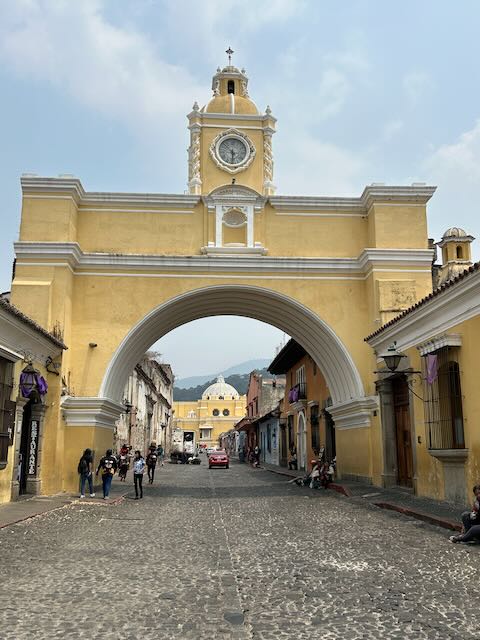
Antigua is a sweet, colorful, and walkable little city. The climate is pleasant – 70’s during most days, 60’s at night, with light humidity. The buildings are colorful with a colonial vibe, and the streets are made of cobblestone. There are many beautiful cathedrals with intricate designs both inside and out. The city is also full of ruins. The Spanish word “antigua” translates to “ancient” in English. At the city center there is a beautiful plaza called Plaza Mayor, with fountains and gardens, surrounded by a large cathedral, an art museum, and many cafés and shops. About a 30-minute walk from the city center, there is an overlook point called Cerro de la Cruz or Hill of the Cross. The well-maintained path to the top of the hill is made of concrete steps that are surrounded by tall wispy trees. Once you arrive at the top, you are greeted by breathtaking views of the city, as well as the two volcanoes that surround Antigua – Fuego (the active one), and Agua (the inactive one). Walking to Cerro de la Cruz became a daily activity during my stay in Antigua, and one of the only times I could enjoy some peace and quiet.
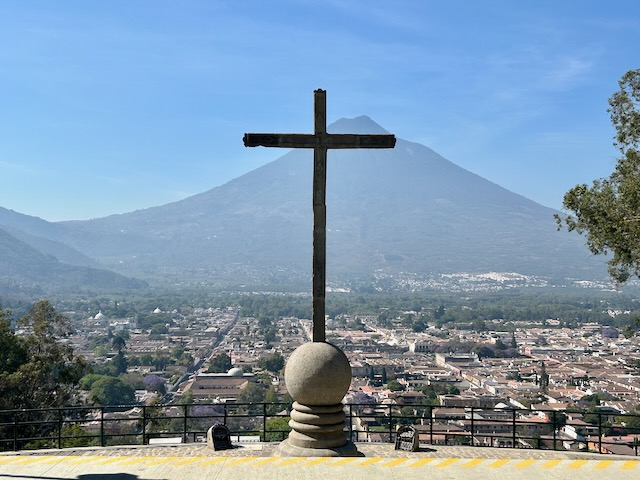
Like many central American cities, Antigua can be noisy and chaotic. The traffic is often heavy and the cars and trucks omit thick pollution. Many locals drive motorbikes which can be loud and obtrusive. The structures are built nearly all the way to the street, with small, uneven sidewalks only wide enough for one person. The noise and pollution seem to reflect off the buildings, magnifying their intensity. One of my favorite pastimes when I travel is walking – which is also my mode of transportation. However, walking around Antigua was far from relaxing, which is one of the reasons I started walking up to Cerro de la Cruz every morning. It would become crowded during the day, but the mornings are peaceful, and the air is clean. Once I’d reach the top, I’d sit for 15-20 minutes in silence or listen to a guided meditation. This became one of my favorite parts of my day and something I still miss to this day.
My first month in Guatemala was not easy, but I’ve found this to be the case for many of my longer international trips. The first month is the transition time, while I figure out the lay of the land and settle into my new routines. This particular trip came with some added discomfort because of the health challenges I had been navigating. I started working with a naturopathic doctor a few months prior and she discovered from my bloodwork that I had some vitamin deficiencies. She prescribed several supplements, so I had to haul three months’ worth with me in my suitcase. My primary symptoms were fatigue, insomnia, and body aches, all intensified by any sort of stress. The stress of traveling to Guatemala and adjusting to the lifestyle exaggerated my symptoms for the first few weeks, so much that I considered cutting my trip short and returning home. But the bigger part of me wanted to push through because I didn’t know if or when I would have the opportunity again to do something like this. And so, I stayed.
During my first week in Antigua, I met with Harold and he connected me with the language school. I met with Eddy, the owner of the language school, a couple days later to discuss packages. He laid out my options of either private tutoring alone, or both private tutoring and a homestay. The packages were very affordable and the homestay, which included three meals a day, was cheaper than staying in the Airbnb with no meals. I decided to book the private tutor for 10 weeks beginning the second week of my trip, and the homestay for the last 8 weeks.
My tutor’s name was Karla. She was a young Guatemalan woman in her 30’s, from Jocotenango, a nearby pueblo. She would travel by bus to Antigua each day for our four-hour lessons. For the first few weeks, she came to my Airbnb since I had a table and chairs. Karla spoke almost no English, which made the lessons equally challenging and effective. I was forced to push myself out of my comfort zone and start speaking in Spanish, despite my self-judgements. The first couple weeks were the most difficult. I felt awkward and embarrassed and at times helpless. I am a perfectionist, and speaking Spanish was something I was far from perfect at. I would count down the hours until we finished, after which I was completely drained. My health symptoms flared up because of the amount of mental energy I was exerting. I struggled to sleep at night and suffered severe fatigue and pain during the days. But little by little, I started to relax and gain confidence.
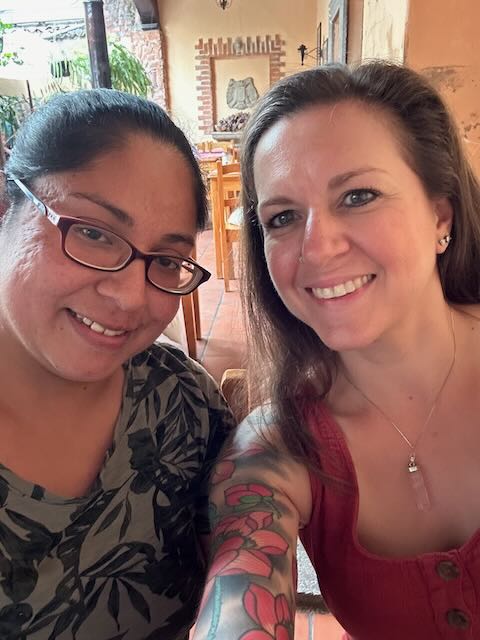
Karla’s presence was warm, safe, and maternal. Her smile could be heard through her voice which eased my insecurities. She was patient and would speak slowly and repeat herself often. We would spend the first hour catching up on what had happened since we met the day before, how we slept, and what we ate. We would then switch to grammar lessons. She taught from a grammar book, and I would write notes on note cards from which she would quiz me. Then we’d switch back to conversation for the last hour of our lesson. We used the translation apps on our phones to help us when we would get stuck. As time passed, my lessons with Karla became my safe space and the awkwardness dissipated. It was the one part of the day where I felt safe making mistakes. She would gently correct me, without making me feel stupid or inferior. She shared intimate details with me about her life, and I learned so much about the culture. She shared about her struggles to find work and the corruption she and other Guatemalan women experienced on a day-to-day basis. I shared with her about my life, and she loved to hear my stories and was particularly curious about what it was like to be a queer woman.
Karla lived with her parents, her two younger sisters, one of whom had a newborn baby, and her husband and young son in a small house with only four bedrooms and one bathroom. When she wasn’t busy teaching Spanish to tourists, she worked hard at home. She cooked for her family, cleaned and did laundry daily, and took her son to and from school by tuk-tuk, a three-wheeled, open-air moto-taxi. Guatemalans are very clean people, and the women spend many hours scrubbing their homes and handwashing clothes daily. Karla’s husband worked at a factory 12 hours a day, six days a week. He rode the bus for an hour to and from work, and each week he would switch between working the day shift and the night shift. He earned only around $350 USD per month. Karla’s tutoring work was spotty and seasonal depending on tourism, and she was paid only a fraction of what I paid the language school for our lessons. Between her and her husband’s salaries, they didn’t make enough to afford a home of their own, and she, her husband, and her son all shared a room.
Karla also shared with me about her family. She had another sister, who lived in Jocotenango with her husband and three daughters. She had struggled with complications during all her pregnancies, and her doctors had advised her not to conceive again. But because of their strong devotion to the Catholic religion, she refused to take birth control and ended up pregnant with her fourth child. She experienced severe complications during her pregnancy and was in and out of the hospital multiple times during the time I was working with Karla. The hospitals in the Antigua area were not very good, so she’d have to take the bus to Guatemala City for care. Her husband worked for the same factory that Karla’s husband worked for, and they eventually let him go because of the time he had to take off work to take his wife to the hospital. She eventually went into labor six months into her pregnancy and nearly died during childbirth. She and the baby both managed to pull through, but she suffered a long recovery and her baby spent several months in the hospital in Guatemala City. The hospital wouldn’t feed the baby, so she and her husband would spend hours on the bus going back and forth between Jocotenango and Guatemala City to visit and nurse the baby. The public buses are crowded, bumpy, and can be dangerous, and she was recovering from a painful delivery and emergency hysterectomy. Hearing stories like this makes me enormously grateful for the freedoms of being an American woman.
I moved into Eddy’s house after my Airbnb stay ended. Eddy lived in a large house in central Antigua, with his family and multiple travelers. They rented their extra rooms to travelers taking language lessons and participating in homestay. During my 8-week stay with Eddy’s family, I met travelers from the US, Canada, Ireland, England, and China. We were required to speak only Spanish in the home, especially during meals. This was challenging and intimidating, and I stayed mostly silent during the first month of my stay. I finally started to break out of my shell during the second month and did my best to take advantage of the added opportunity to practice the language.
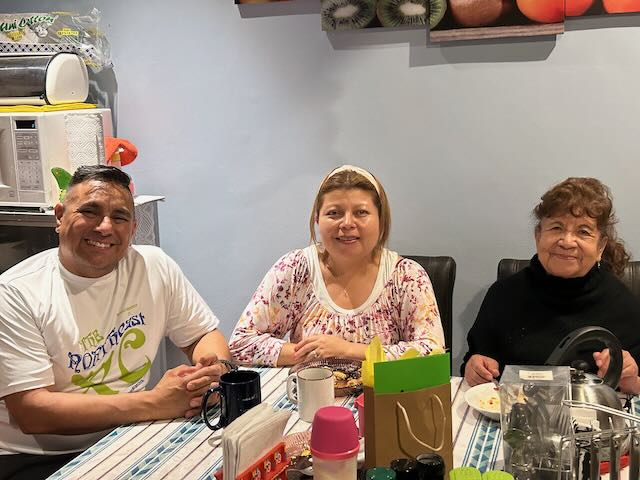
Eddy’s family was kind and patient and accustomed to people learning the language and living in their home. Eddy’s children, Nataly and Arnold were young adults who were friendly and helpful. They would help us with our Spanish if we struggled and made me feel welcomed and cared for. In Guatemala, it is common for children to remain at home until they marry, even if they go to college or start working. Eddy’s wife, Mónica, cooked our breakfasts and dinners, and although she was a kind and caring woman, she was not a great cook. The food we were served was often overcooked, bland, and processed, and eggs and black beans were part of nearly every meal. Elena the housekeeper, however, was the saving grace. She cooked elaborate lunches every day and the whole family would join. Lunch is the most important meal of the day for Guatemalans, and the entire family, including extended family, gathers together. Elena cooked us traditional Guatemalan dishes including Pepián, a thick meat stew made from a roasted tomato and pepper sauce thickened with toasted pumpkin and sesame seeds; Sopa de Frijol, a black bean soup; Jocón, a chicken stew originating from Mayan K’iche’ culture; and fish in the round. She would make a different flavor of agua fresca each day, a refreshing drink made by blending fruit, flowers, seeds, or grains with water and sugar. On Sundays, Mónica would buy fresh tamales from the Mayan and Guatemalan women who sold them at the markets for our dinner.
Eddy and his wife also owned an appliance store that they ran out of the front of the house, and a tour company which Eddy managed. Mónica’s sister and mother were often at the house during the day, working in the store and joining us for lunch. My room for the first month was in the middle of the house near the kitchen and the people constantly coming and going was like living in an airport that never sleeps. The walls were thin and I had virtually no privacy or quiet time outside of my morning walks to Cerro de la Cruz. I shared a bathroom with two other travelers while in that room but was able to move to a bedroom upstairs with a private bathroom for the second half of my stay. Overall, I am grateful to have experienced the homestay, and it certainly immersed me in the culture and the language. It was an unforgettable, enriching experience, and I can confidently say that I wouldn’t do it again.
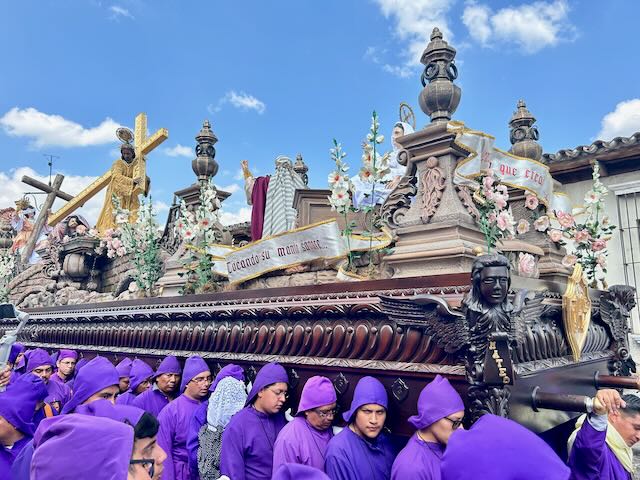
One of the most special and sacred experiences I had was watching weekly processions during the seven weeks leading up to Semana Santa, or Holy Week. I had no idea this would be taking place during my stay until after I arrived. Many Guatemalans are Catholic, and are deeply devoted to their traditions. Processions are one of their most elaborate traditions. Each Sunday, beginning the week of Lent until Easter Sunday, a different cathedral from a nearby village builds andas procesionales, or processional floats made of large wooden structures depicting different scenes with Jesus and Mary. The andas are carried by members of the church wearing purple tunics, arranged based on height. Each group carries the anda for a few blocks before trading to the next group. The processions begin at the hosting cathedral and the andas are slowly carried for 12 or more hours to and throughout Antigua and eventually back to the hosting village. In front of each anda there is a full marching band, along with other helpers burning incense, holding signs, lifting power lines, and cleaning up after the procession. The tradition is elaborate, and Guatemalans spend a lot of time and money creating these celebrations. During Semana Santa, there are processions held every day, and some days there are two or three. People from all over the country and even neighboring countries come to Antigua for the festivities.
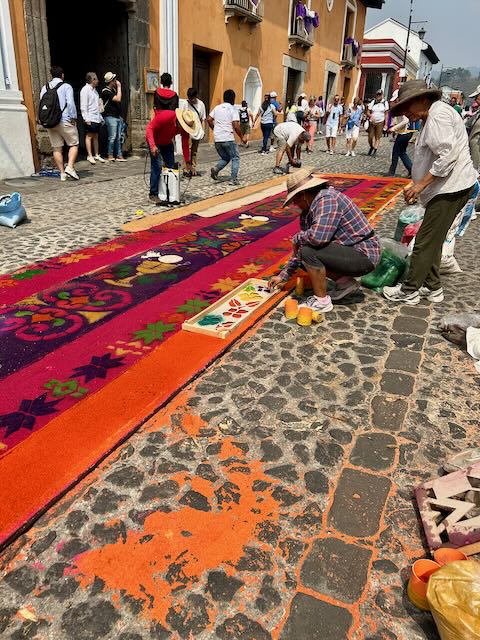
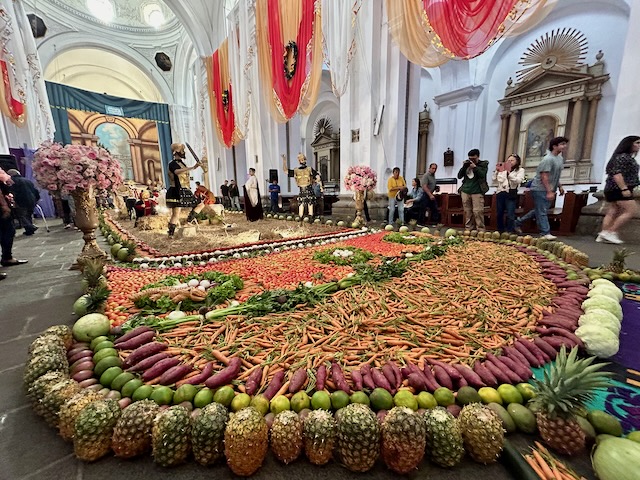
Another important piece of the tradition are the alfolmbras, or “carpets.” The streets are cleared of all parked cars and blocked off from traffic, so locals can build these carpets which are made of colored sawdust, flowers, and fruits and vegetables. The people work for hours, carefully stenciling brightly colored sawdust and perfectly arranging flowers and vegetables into beautiful designs. Water is sprayed over the alfombras to keep the sawdust from blowing away in the wind. The procession walks over the alfombras and the remains are swept up and disposed of in a large truck that follows behind each procession. During Semana Santa when there are multiple processions staggered throughout the day, the streets are blocked off, restaurants remain open 24/7, and people stay up throughout the night and early morning hours creating alfombras and walking with the processions.
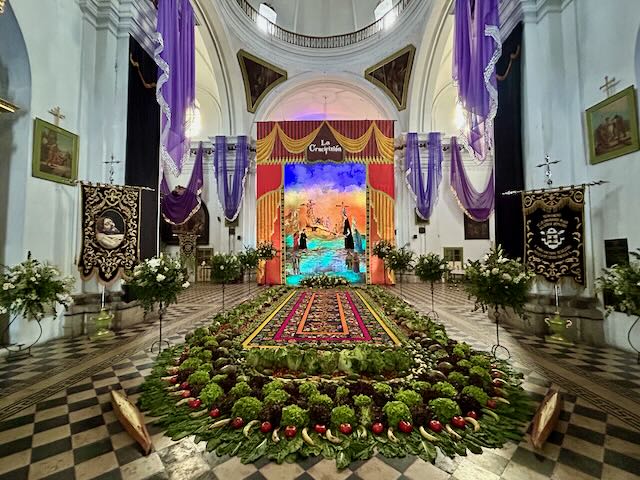
On Sundays during this time, and every day during Semana Santa week, cathedrals in and around Antigua create velaciones, or “viewings.” They build beautiful alfombras inside of the cathedrals and create scenes depicting Jesus’ death on the cross and subsequent resurrection. The velaciones are free to the public and lines of hundreds of people waiting to see them wrap around the streets. Karla and I visited several velociones during our lessons.
Although I am not Catholic, it was inspirational to witness the devotion and dedication of the Guatemalan people. The way the people unite to work hard for many hours creating beautiful art gave me a sense of hope and reassurance. Of all my travels, this was the most cultural experience I’ve had between my daily conversations with Karla, living with Eddy’s family, and witnessing the processions and velaciones. I learned so much about the Guatemalan culture, and ultimately about myself. Something I always get from my travels is perspective. The hardships that Karla shared about life as a Guatemalan woman made me so grateful for the privilege and freedoms I have as a queer American woman. My heart aches for the suffering and corruption that is still a part of everyday life in many cultures. I left Guatemala feeling filled up with not only with a deeper understanding of the Spanish language, but with a profound appreciation for these extraordinarily beautiful people.